Gordon Harper
Good Morning, MidnightGordon Harper is Aether’s commander and, during the long communications blackout, the crew’s human tether to Earth. His command is expressed less through ceremony than through attention: he learns what each crewmember needs, tries to keep them engaged with the present, and takes responsibility for decisions whose consequences cannot be known in advance. The same care shapes his closest connection with Sully, with whom he shares a growing intimacy as the crew approaches an uncertain return.
Identity and preparation
Harper arrives at the Houston training facility a week after the rest of the crew. He has undergone a separate orientation in Florida, apart from the group and focused on preparing him for command. By then, the others have already formed a bond. Harper enters their established circle during a demanding session at the Neutral Buoyancy Lab, where the crew practices extravehicular repairs on a mock-up of Aether. As Sully and Devi come out of the pool, he is already talking with the others: joining Tal’s jokes, asking Ivanov about an astrogeology article, and greeting his old friend Thebes.
Sully watches Harper while the crew helps her out of the water and suit. She notices that he listens more than he speaks and distributes his attention among the men rather than dominating their conversation. The group appears at ease around him, and she forms a good first impression. His ability to enter a team that has already bonded, without insisting on being its center, anticipates the quieter form his leadership will take aboard Aether.
Harper is already an experienced commander, having led at least half a dozen missions, and Sully remembers that he has flown in space more often than anyone else. She estimates his record at ten or eleven spaceflights but cannot recall the exact number. During the flight that carried the crew to Aether, he commanded the shuttle with Tal beside him and brought them through the atmosphere. At the formal introduction, the space-program director, Inger Klaus, spends about fifteen minutes recounting his qualifications, honors, and accomplishments. Harper appears embarrassed by the extended biography. When he addresses the crew, he speaks from prepared notecards and presents the mission as a shared step into the unknown rather than a personal achievement.
Command during the blackout
The crew’s difficulties change after the Jovian mission. Its initial tranquility passes, while the effects of the communication blackout and the long journey home begin to weigh on everyone. Harper moves from pod to pod, checking on each member and trying to preserve their sense of connection. Nearly three weeks without contact with Mission Control, with no explanation for the silence, prompts him to call a crew meeting after dinner and recreation. He frames it as a chance to review what they know, even though the gathering makes clear how little they can establish. The crew responds unevenly: some listen, Tal shows visible unease, and Ivanov continues running on the treadmill. Harper’s effort to bring them together cannot resolve the uncertainty, but it gives that uncertainty a shared setting.
His support takes different forms with different crewmembers. He asks Devi to explain the ship’s life-support systems, radiation shields, and the centrifugal gravity of Little Earth, drawing her attention back to technical work and immediate concerns. He plays video games with Tal and listens to his advice. When he visits Ivanov’s lab, Ivanov becomes more civil and explains his research. With Thebes, Harper draws on an old friendship and the older man’s steadiness; Sully sees the two of them helping sustain the rest of the crew. These interactions make Harper’s leadership practical and relational: he does not offer a solution to the blackout, but he keeps finding ways for the crew to remain occupied with one another and with the work at hand.
Relationship with Sully
Harper and Sully build a companionship around conversation, shared activities, and sustained attention. He listens with her to signals in the communications pod, plays cards, and sketches her profile while she studies Jovian data. At the table on Little Earth, they spend hours together. She sometimes reads scientific papers aloud while he exercises; he teases her about their stiff phrasing, and she suspects that his questions about the research are asked chiefly to encourage her. They also talk about home, though the subject carries uncertainty rather than comfort while Earth remains unreachable.
Harper’s interest in Sully includes asking what she is thinking, a question that catches her off guard. She answers by recalling Goldstone, where her mother worked in the signal-processing center. On another occasion he postpones asking her a question until they land, explaining that he needs something to anticipate and that the others need that as well. The exchange links their private rapport to the crew’s larger predicament: a possible landing becomes a source of hope even when its circumstances remain unknown.
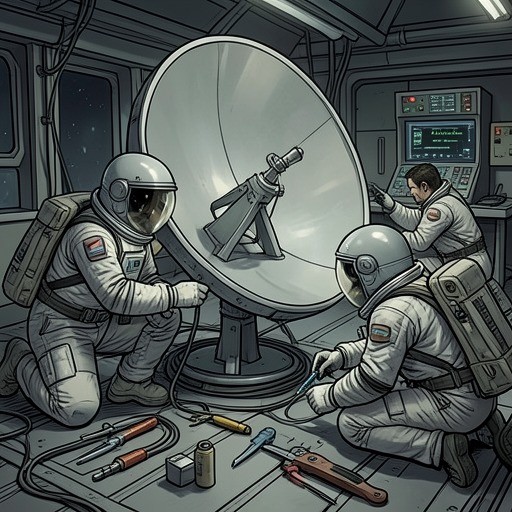
Their closeness does not make Harper’s command responsibilities disappear. When he prepares for the antenna-repair spacewalk, he tells Sully that she and Devi must undertake it. He has spent hours considering the assignment and is uneasy about Devi’s emotional readiness, but judges that Thebes may not be able to improvise outside the ship as well as she can. Before the walk, he insists that Sully promise to abort and return to the airlock if anything goes wrong. He reminds her that restoring communications is not worth losing a crewmember, since they might try again or wait until docking with the International Space Station. His appeal is personal as well as procedural: he acknowledges their friendship but needs her to follow his orders.
When Devi dies during the spacewalk, Sully is left holding the communications dish and unable at first to process the voices from inside Aether. Harper responds when she calls the ship, and she asks him to tell her what to do. The moment reverses their ordinary pattern of companionship: the commander who has tried to keep the crew connected must now guide Sully through a crisis in which conversation cannot undo the loss. His measured response and Thebes’s presence on the comms provide a line of direction while Sully remains responsible for finishing the work.
Return and significance
Harper’s voice also becomes part of the first radio contact with Augustine. Speaking as Aether’s commander, he identifies himself and Sully to Augustine and says the crew is glad to speak with him. The exchange establishes Harper as the representative of the returning spacecraft, while also confirming that Sully is with him and already known to Augustine. The contact offers a human connection across the communications silence, but Augustine’s report that he has heard nothing for over a year since the evacuation gives the crew reason to fear that Earth’s situation is worse than they had understood.
As Aether approaches Earth, Harper faces a decision that cannot be settled by seniority or personal preference. The crew discusses reentry while Earth fills the view from the cupola, still an unknown home. Harper proposes drawing straws, reasoning that a random method is the fairest available when they do not know what they will find below or whether a Soyuz could be launched again. The crew agrees. His proposal does not make the danger manageable; it makes the allocation of that danger collective rather than an arbitrary exercise of command.
After the meeting, Sully watches the planet pass beneath Aether and considers the family and life she may never return to. Later, she enters Harper’s bunk, having decided she wants to be near him while the chance remains. He moves over to make room, and she lies beside him. The scene is quiet and restrained, but its placement matters: after the crew has discussed who may descend and Sully has let go of plans for a future on Earth, their closeness becomes a form of present-tense connection. Harper’s narrative role is therefore not only to command Aether through isolation. He also helps make connection possible—among the crew, across the radio link to Augustine, and, most personally, between himself and Sully—without promising that any of those bonds can restore the world they left.